Showing posts with label Shawl. Show all posts

Wednesday, July 04, 2007

Midsummer Night Shawl


It's the Fourth of July, and I'm in a little coastside town near San Francisco called Pacifica. Pacifica is known for its foggy days. In fact, we even have a Fog Fest every September, a street festival dedicated to wet mist, with sand castles, children's games, food, fun and a local drink called a Fog Cutter that would burn the chill off of anyone.

But I was born in San Francisco, which has its own share of foggy summer days.

As anyone who grew up in City knows, the number of times the fireworks have been clearly seen over San Francisco Bay on the Fourth of July can be counted on one or maybe two hands.

(As I get older, I have to add a few more fingers.)


Where I grew up, on Russian Hill, every Independence Day we would walk to the top of the crooked street, at the apex of Hyde and Lombard Streets, and look down the hill toward Alcatraz, sticking up like an umbrella in the cool summer Bay tea.

Typically, we would see the fog and a few glowing spots of color. We would shake our heads, zip up our parkas, and walk back down Hyde Street to Swenson's for an ice cream cone.

Our weather ranges from cool to cooler on most summer nights. The misty fog spreads inland from the Pacific Coast in the late afternoon, cuddling the City with its damp white blanket. This may seem
romantic when dining at the Carnelian Room, 52 stories above the Financial District, where you can see only fluffy mist beneath and blue sky above you.

Or, it may seem ominous and exhilerating as you perch at the edge of a cliff at Land's End and watch the creeping white tufts crawl through the Golden Gate, the bridge perm
eating the fog into white tendrils that merge together over the Bay, and finally climb the hills and drift into the valleys where they dissipate into nothingness.

We natives can feel it out there.
We can smell the saltiness in the afternoon wind. No one where we live has air conditioning.

Cool summer weather calls for a lovely midweight shawl -- something to wrap around the shoulders at the first sign of foreboding afternoon breezes.


A few months ago, I began corresponding with Margaret at Inspirations Yarn about the possibility of test knitting her latest shawl pattern.

I had sampled some of her beautiful hand-dyed yarn and loved the quality and her color sense. She sent me the pattern and yarn, and I got to work. I was very pleased with the clarity of her writing.

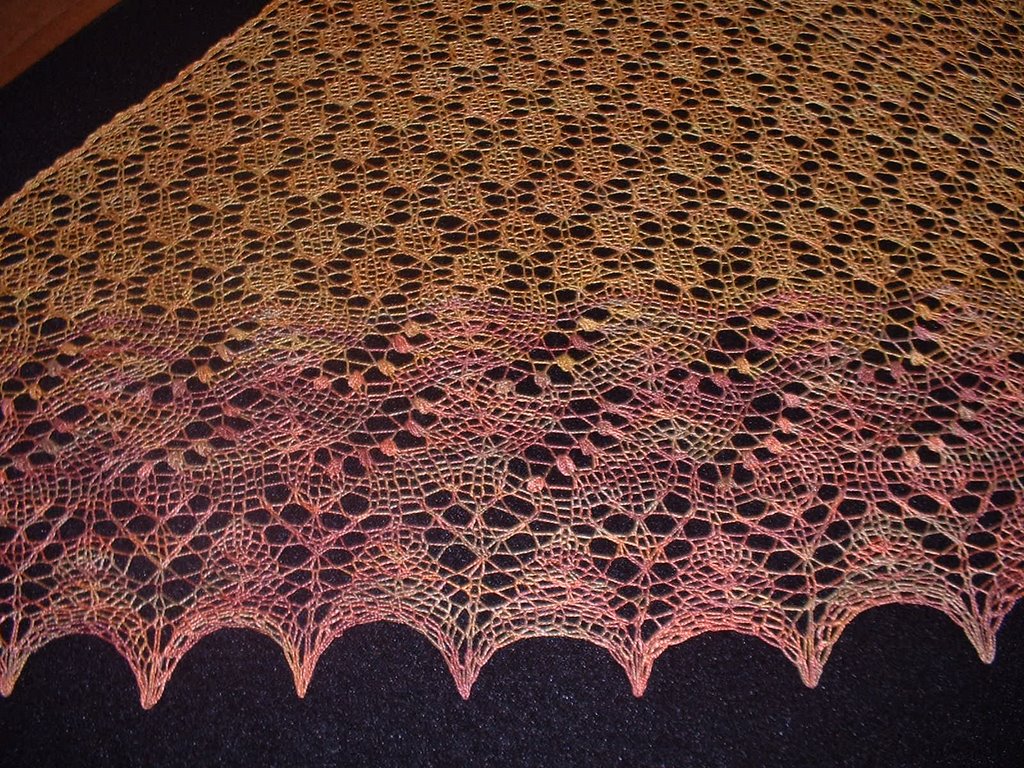
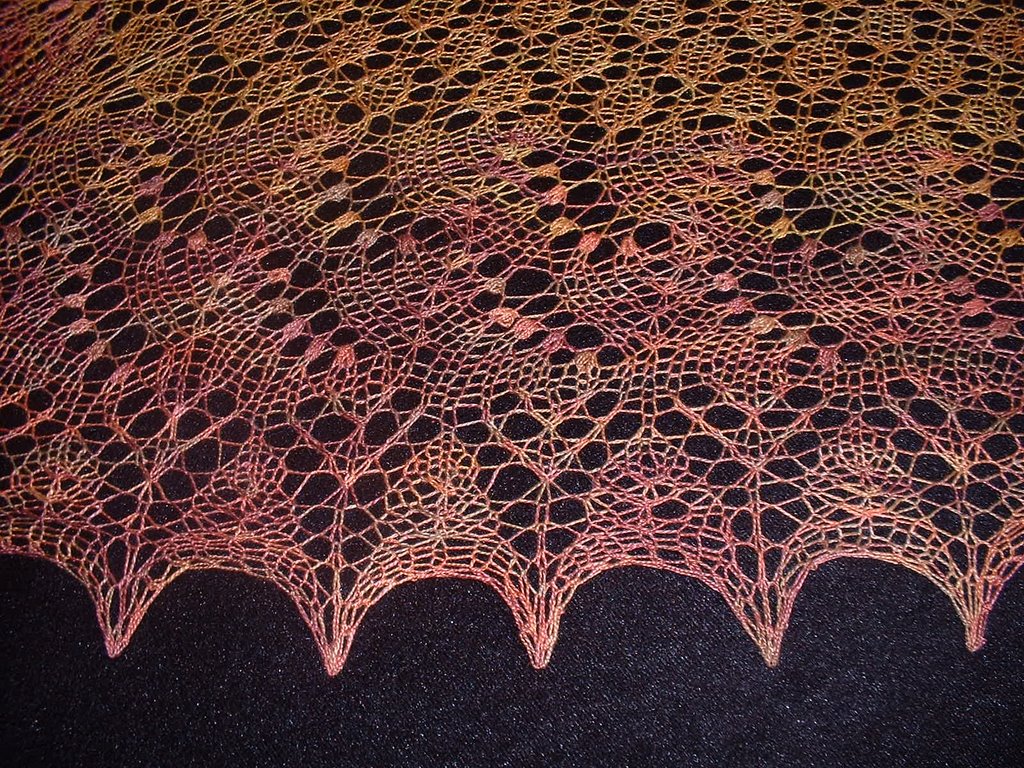
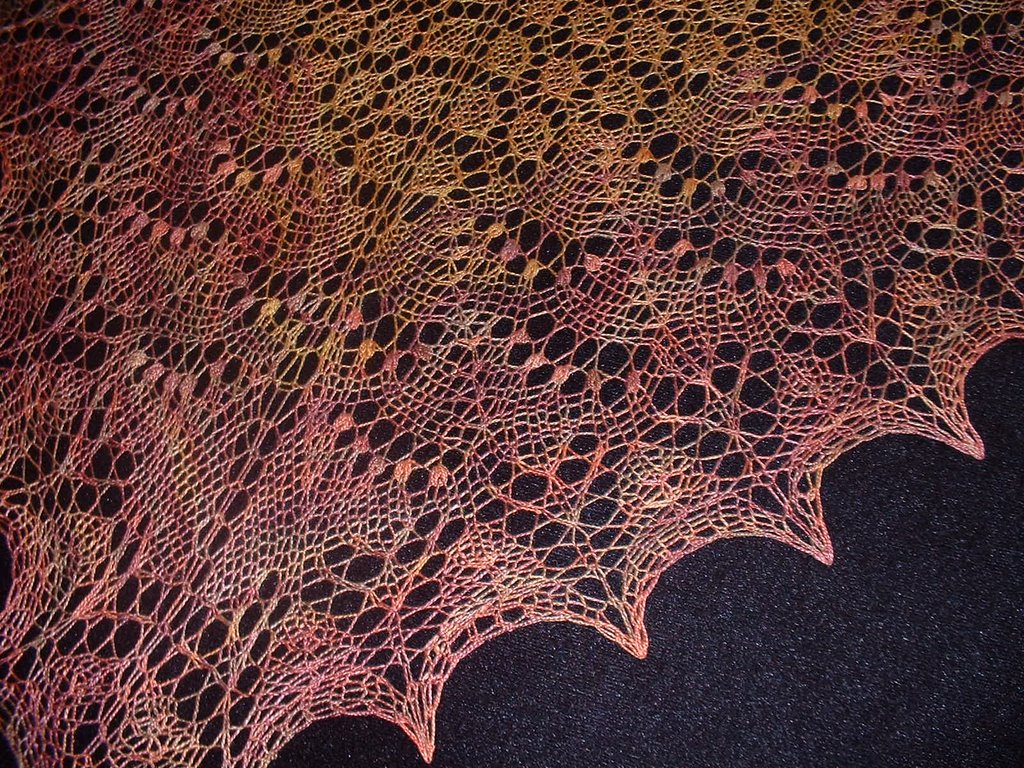
The Midsummer Night Shawl is knitted in an Elfin Lace pattern that is straightforward and somewhat easy to memorize.

I would call this an intermediate lace pattern, although beginners would be able to tackle this shawl while learning a few new tricks, such as knitting on a border or chart reading. The pattern is written out as well as charted.

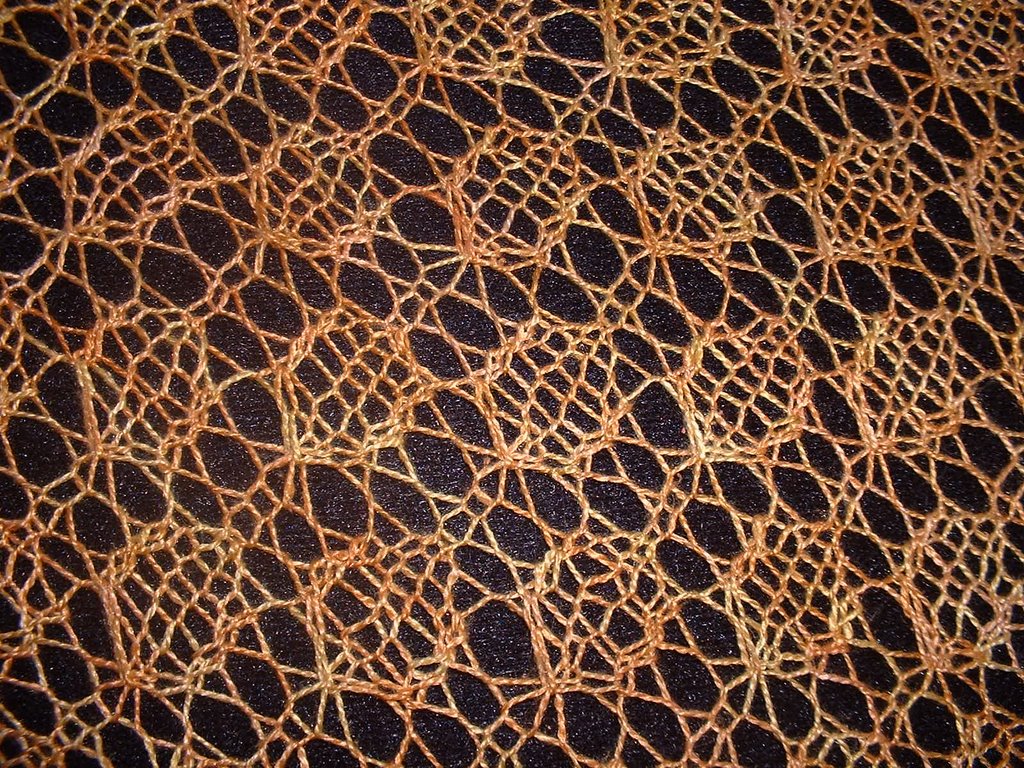
The yarn color is Heirloom Rose, a gorgeous blend of rose, peach, and pink that blend together in bright harmony. The colors would compliment any skin tone, and I love the way the lace pattern shows off the yarn and the design equally well.

Sunday, March 18, 2007

Gracie Shawl - Finished!

Last weekend, I finished the Gracie Shawl. The pattern is from Stahman's Shawls and Scarves by Myrna Stahman. I used one skein of Schaefer's Andrea, 100% silk laceweight. The "Elena Piscopia" colorway includes blue, gold, goldish green, rust, and magenta. This skein of Andrea was 1,093 yard, purchased from Greenwich Yarn in San Francisco. Gracie took about one month to knit, from start to finish.

With so many colors in the yarn, I was concerned they might obscure the lace pattern, but it turned out beautifully. The colors add another dimension.

Since this Faroese shaped shawl starts at the top and expands downward, I didn't worry too much about not having enough yarn. I could stop at the end of any repeat, with enough yarn left to finish the border. Swatching is important in most cases, especially in lace, to determine the finished size and yardage required.


I chose a different border than the one recommended in the book. Instead of the Gracie border, I used the Idella border, which is a bit wider and more "holey" than the Gracie border. The Idella border has the same number of rows per repeat as the Gracie border.

In either case, the border is knit perpendicular to the bottom of the shawl. I used a DPN the same size as my circular needle and knit the border stitches according to the chart. The last stitch of each border row is knit together with one stitch of the shawl body on each right side row. The wrong side border rows are knit plain.

Using a DPN is the fastest way for me to flip the narrow border back
and forth as I am knitting. Myrna Stahman recommends knitting to-and-fro (knitting backward for wrong side rows) to avoid all this flipping. For me, neither way is any faster.

I wove in a few ends, not cutting them. The ends should be left hanging until after blocking. During the blocking stage, they may draw in as the lace is stretched.

As I usually do when blocking a shawl, I quickly soaked the lace in cool water with a drop of liquid soap added. Then I rinsed it and gently squeezed out the excess.
The water was orange! I was concerned that the dye had not properly adhered to the yarn because the water was REALLY orange. I rolled the wet shawl in a dark towel, hoping for the best. I was afraid a lighter towel would be stained with orange dye.

Even with the loss of some of the rusty orange dye, all the colors still looked vivid. Whew. Only the rust color seemed to have softened, but it wasn't dull.

The shawl is bigger than my blocking board, so I chose to block it one half at a time. I threaded two 1/16" welding rods through the two lines of holes that border the center section.
These became my anchors. I pinned the rods to the board, and stretched the lace out to one side only. I had enough room to block the left side of the shawl into a nicely curved shape. After a few hours, I unpinned the left side and then blocked the right side in the same manner.

This is the second shawl I've made from Stahman's Shawls and Scarves. The first was the Susan shawl I made for my sister, which you can see here.

Saturday, February 10, 2007

Gracie Shawl ... and more yarn

I wasn't going to buy any new yarn before Stitches West, the knitting convention at the Santa Clara Convention Center on February 22-25, 2007. But ... the best laid plans of mice and men often go awry.

After fondling Schaefer's Andrea 100% silk at my
LYS on several visits, I was smitten enough to take some home. It was truly love at first sight. Schaefer's saturated colors are intense in silk, and somewhat antagonistic.

Knit lace with space-dyed yarn? How dare you! Most lace knitters know that a lace pattern can look muddled when using variegated yarn. Why knit a complex pattern of holes with a yarn that doesn't show off the design?


I am daring to knit the Gracie Shawl, a Faroese shawl pattern from Stahman's Shawls and Scarves, by Myrna Stahman. The lace pattern is repetitive and somewhat geometric. I think it is enhanced by the lovely color changes in the yarn.


Andrea comes in a variety of handpainted color combinations, all named for "Memorable Women." The colorway I'm using is "Elena Piscopia." Schaefer's Andrea is 100% silk, 3.5 oz and 1093 yards. The gauge is 8 sts to the inch in stockinette.

Elena Piscopia 1646-1684

Elena Piscopia was born into a Roman family whose ancestors included cardinals and popes. She was recognized as a prodigy by the age of seven and spoke seven languages, played several instruments and composed music by the time she was seventeen. Her father refused to allow her to enter the Benedictine Order, for which she had secretly prepared, and instead she became the first woman to study theology at the University of Padua and the first woman to earn a doctoral degree. She taught mathematics at the university for the rest of her life, yet it would be over 300 years before another woman earned a doctorate there. Her achievement is honored by a marble statue in Padua and a stained glass window at Vassar College in New York.

Now, I have three shawls on the needles: Shirley Paden's Shetland Lace Shawl, the Gracie Shawl, and a sample crochet cape for Kristin Omdahl's line. You would think that I have enough in progress, and that I don't need to buy even more laceweight yarn.

Well,
Colourmart has been calling my name for many moons. This yarn vendor on eBay sells mainly cashmere remainder yarns from Italian and Scottish mills.

I saw one that I simply had to try, and the price was right. I won this lovely red cashmere/merino/viscose blend for only $11.00. The weight is very light, even lighter than Andrea, and similar to the weight of the black wool I'm using for the Shetland Lace Shawl.

I don't yet know what this is going to be, but it deserves to be something beautiful. Maybe the Paisley Long Shawl from Fiddlesticks.

Monday, January 15, 2007

A Big Cone of Yarn for a Shetland Shawl

This is what happens when you buy a gigantic cone of wool/silk yarn from eBay. Yes, it's 50% wool and 50% silk, just like the well-known Zephyr by Jaggerspun.

But had I read the description more carefully, I would have noticed that the weight in the eBay listing was 2/23. So, what's wrong with this picture?

The wool I bought is lovely, but it is NOT from Jaggerspun. Jaggerspun Zephyr comes in 2/18 lace weight. (It also comes in DK weight.) This cone of yarn at 2/23 is somewhat thinner than the Jaggerspun Zephyr.

The seller called this yarn Zephyr, because that is what's on the label. In fact, if you hunt around, you'll find many different companies have a yarn called "Zephyr." So, what did I get for my $20?

How to Determine Yards Per Pound from a Cone Label


The cone label says the yarn is from Phoenix Dye Works in Cleveland, Ohio. The yarn weight on the label is 2/23. The actual weight is about 2.5 lbs, including the cone itself.

Jaggerspun lists its 2/18 wool/silk at 5,040 yards per pound. I know that 2/23 is a skinnier yarn, and is going to have more yards per pound. So how many yards of yarn did I buy? And how does 2/23 yarn compare to 2/18 yarn?

The first number of the fraction is the number of plies. A ply is a single strand, so I have two plies.

The second number of the fraction is the yarn thickness. The yarn thickness is determined by the number of times the yarn is spun at the worsted standard of 560 yards per pound.* (Cotton and linen use a different standard.)

The yards of yarn on my 2/23 yarn cone, which weighs about 2.5 lbs, could be calculated like this:

Multiply the bottom number times 560:

23 x 560 = 12,880

12,880 divided by 2 plies = 6,440 per pound

6,440 x 2.5 lbs (total weight) = 16,100 yards (wow!)

I don't know how much the cardboard cone weighs, but I would need to subtract it from the total weight to get an accurate number of yards. A good estimate would be about 0.10 lbs for the cone. In that case, I would substract 0.10 from the total weight of 2.5 lbs. Then I would calculate:

6,440 x 2.4 lbs (total weight minus the cone) = 15,456 yards.

Truthfully, I will probably never use the entire cone of this yarn, even it were less than 10,000 yards.

*Note: After some additional reading, I corrected the worsted standard to 560 yards per pound. This seems to be the most often used number. Some websites use 500, but that seems to be the minority.

The Shetland Lace Shawl

I decided to knit Shirley Paden's Shetland Lace Shawl from Vogue Knitting Fall 2005 with my now infamous Zephyr yarn. This must be my favorite issue of VK, since I've made at least three items from it.


If you recall, the lace shawls in this issue did not come with charts! Lace knitters around the world were up in arms about this. If you are a lace knitter, you know what I mean. Vogue called it a print space issue and promised to post the charts on their website.

For me, charts are a necessary part of any lace pattern. If a pattern doesn't have a chart, I'll make one myself. A chart allows you to see where the increases and decreases fall in relation to the previous row. Have you ever tried to knit a lace pattern like this?:

Row 16: 1 selvage st, k2, yo, k2tog, k1, yo, sk2p, *yo, k1, k2tog, yo, k3, yo, k2tog, k1, yo, sk2p; rep from *, end yo, k1, k2tog, yo, k2, 1 selvage st

Imagine reading rows and rows of this, without seeing on a chart where the yarnovers are supposed to line up with the previous row's yarnovers.

And, to make it even tougher, this is a Shetland lace pattern, with knitted lace on every row -- no plain rows. Technically, "knitted lace" is lace on every row. "Lace knitting" is lace on every other row, with plain knitting on the alternate rows.


It took a few months before VK finally published the charts for the Fall 2005 lace shawls on its website. The Shirley Paden Shetland Lace shawl was my favorite. I began to knit with a size 6 needle, then decided the gauge was too large and ripped it out. I settled on a size 4 needle.

With this type of knitted lace, it's difficult to see the pattern unless you stretch out the piece. I stretched it as much as possible and got a good look at the Webs, Spiders and Diamonds in the Shetland lace. The shawl will have four pieces which will be sewn together. The center will be two rectangles, grafted together. A separately knitted lace collar will be sewn to one long side. Finally, a knitted lace edging will go around the entire shawl. This is a big project, and I hope to learn more about Shetland lace shawl construction along the way.

Monday, November 06, 2006

Swallowtail Shawl in Silk - Completed!

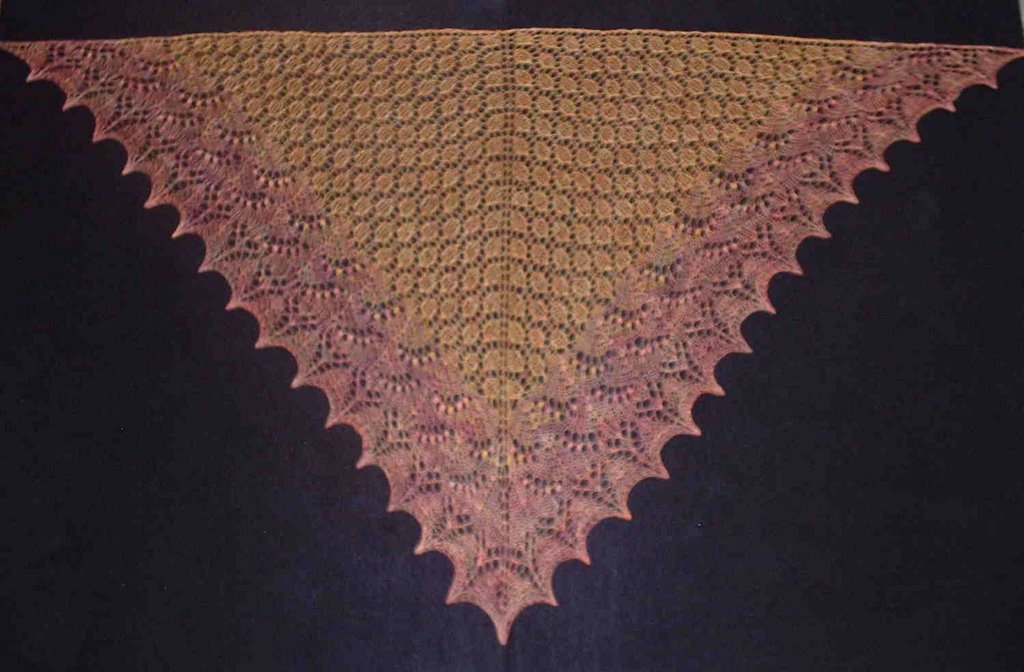
The Swallowtail Shawl is completed! I used two colors of Kaalund Enchante 100% silk laceweight, Silky Oak and Nectarine. Kaalund is an Australian brand, and I purchased it from Greenwich Yarn in San Francisco.

The shawl begins at the top center and is worked outward. The main body is in a Budding Lace pattern, followed by two tiers of the Lily of the Valley border and is finished with a Peaked Edging.

I'd have to say that this is a fast knit compared to other lace shawls I have made. It took less than a month to complete, and I was working on other projects as well, so I didn't work on it every day.


My best decision was made before I began. I chose two colors and wanted a subtle transition from one to the other. I wanted to achieve a "sunset" effect, and I'm pleased with the outcome.

The first part in the Budding Lace pattern is all in the color Silky Oak. The color change occurs in the first tier of the Lily of the Valley border. I knitted two rows of Silky Oak and two rows of Nectarine, then two rows of Silky Oak and two rows of Nectarine again. These two dyelots have a common golden color, so the transition was as subtle as I had hoped. I also like the way the nupps in the transition section are multicolored as a result of the color changes.


I've read about the "nupps" on various blogs. The general knitter consensus seems to be: we love how they look, but we hate making them. I think the roundness of the true nupp makes a difference. True nupps are five stitches purled together (p5tog). Slip 2, purl 3 together and pass the slipped stitches over is another way of accomplishing a nupp, but the shape is slightly different and not quite as round. See my previous post to learn how I accomplished these round nupps without going crazy.

The second tier of Lily of the Valley and the Peaked Edging is worked completely in Nectarine.


Blocking was fast and easy. I threaded a 1/16" welding rod through the eyelets at the top edge and secured the rod to my blocking board, making sure the right and left corners were pinned down tightly and placing just a few pins under the rod to keep it straight and even. Then I pulled the bottom point down as far as it would go and pinned it to the board.

After that, I pulled the center point of one side out and pinned it, then switched to the other side and pinned the center point, stretching hard each time to open up the lace. I continued in this manner, pulling out a point on one side and the corresponding point on the other side, taking care to keep the points evenly spaced.

After every point was pinned, I went all the way around making minor adjustments to the pins, because as I stretched the lace, some points pulled a little too much to the left or right and I wanted them to point straight out.


Saturday, October 28, 2006

Swallowtail Shawl in Silk


The Swallowtail Shawl from Interweave Knits Fall 2006 issue appears to be everywhere in blogdom. I had decided to make this short, lacy shawl when I first saw it a couple of months ago, before I knew about the knitalong blogs. Yes, there's more than one!

I'm glad I waited to find just the right fiber.

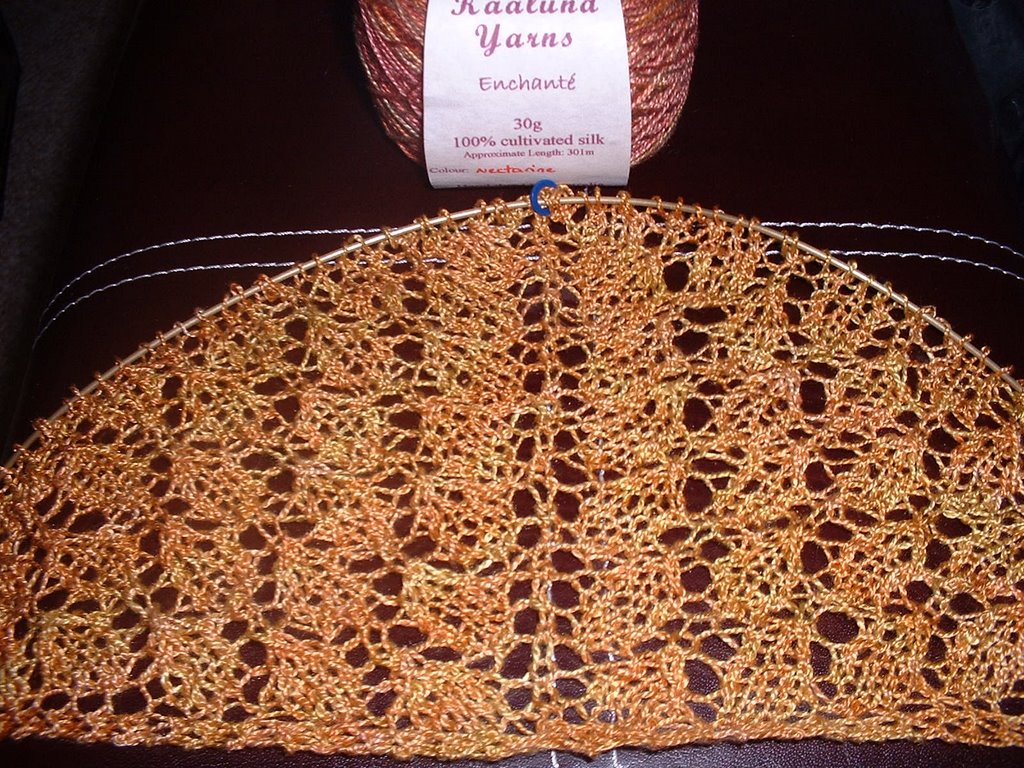
This yarn is Kaalund's Enchante, a 100% silk laceweight. It's a superfine laceweight, but not cobweb. And the
colors! I'm using Silky Oak for the first section - a subtly variegated peach and gold - and I'll finish it off with Nectarine (the slightly more peachy-red yarn ball in the photo). I'm hoping it will look something like a sunset, but the proof will be in the lace.

So far, my only qualm about this yarn is that it doesn't "give" or stretch, so knitting the p5tog's in the Lily of the Valley border is a challenge. I choose to knit these nupps with a small crochet hook. The shawl is on a size 4 circular, and the hook is #5 steel.

What works for me is sliding the hook from right to left under five stitches on the lefthand circular needle, hooking the working yarn and pulling a loop through the five stitches. Then I slide the five stitches I just worked off the lefthand needle and put the new loop on the righthand needle.