Friday, July 03, 2015

Bigger Begonia Swirl

Some knitters have been asking how I made the Begonia Swirl bigger, so my project tips are below.


I decided to enlarge the shawl, and added one begonia per each section (went from 22 to 33 begonias). I used 1,980 glass Miyuki seed beads, rose bronze color, size 8/0.

The delightful yarn from Violet Lynx was hand-dyed in Russia and shipped to the US quickly (about two weeks).  She has some great colors and lots of yardage for bigger shawls. The gradient is all from one skein.


I would recommend about 1,200 yards of laceweight, if you decide to increase the size like I did.  I ran out of yarn on the last four rows, so I used a similar yarn to finish. I think it outlines the flowers.   I’m happy with the result.

Overall, it's lovely work for when you are relaxing, until the flowers! Then much concentration is required -- especially if you are adding beads. It’s not difficult for a lace project, and the gradient yarn produces spectacular results.

PROJECT TIPS:

The construction is a little different than you might expect. You start out with 11 repeats. Then, when you get to the edging, each repeat splits into two begonias - so you have 22 edging repeats (begonias). This is the way it’s written, but I wanted it larger.

To get the larger size, three begonias per repeat, I had to have more stitches at the start of the edging chart. This took some calculating, but it’s not so bad. What you need is 20 sts per begonia at the start of the edging chart. Don’t count the selvage stitches.

To add that extra 20 sts per repeat, you need to keep increasing at the same rate (yo, k1, yo, k2, yo, kxx, k2tog). It gets a little tedious with all that stockinette, but it’s worth it.

When the stockinette (the kxx) is equal to 60 sts, you have enough for three begonias per repeat (33 begonias total). Then start the edging chart.

I would not recommend increasing faster, as this would make the spiral twist too much. I don’t think it would hang right.

I highlighted the stitches on the chart to make adding the beads easier.  These I added with a  size 10 steel crochet hook.

Wednesday, May 13, 2015

Stanwood Ball Winder

For decades, I've wound my yarn from skeins into balls by hand.  That's right, by hand.  I love how the yarn feels as I'm winding and that I can customize the shape and feel of each ball.  I guess I just love yarn!

Well, after much research and hesitancy, I finally bought a ball winder.  Even though I do love a good Zen session of hand winding, this ball winder will help me wind faster, and spend more time knitting and less time thinking about knitting -- even though, thinking about knitting is pretty good, too.

This is a Stanwood Large Metal Ball Winder. I ordered through Amazon, because I get free shipping.  You can order directly from Stanwood, and the price is lower, but add shipping and tax and it costs about the same as Amazon.  The large size will hold about 10 ounces of yarn.  I like that it's a little larger and more heavy-duty than smaller plastic ball winders.

Setting up took about five minutes, with easy instructions that were included.  I've found that it's not very noisy, like some metal winders, due to the nylon gears.

More on this as I get some experience using it.

Thursday, March 26, 2015

Filigrane Spitzendecken

What luck! 

Occasionally, I shop on The Book Depository website for lace knitting books, and this one popped up today. I hadn't seen it before. It's a new release of a Niebling pattern folio, as of March 10 2015.

Filigrane Spitzendecken

Filigrane Spitzendecken


Publisher: Buchverlag Fuer Die Frau
Language: German
Publication Date: 10 March 2015
ISBN 13: 9783897984790

Collecting Niebling patterns is somewhat of an Easter egg hunt -- it's very exciting to find one you haven't seen before.

This may have been out before, and I just never saw it, but I doubt it. I would appreciate hearing about any upcoming publications of Herbert Niebling patterns.

Friday, October 31, 2014

Izzy's Sweater

My cousin Cara sent me this pic of her baby Izzy (Isaiah Benjamin) wearing the hoodie sweater I made for him.  It's a Rowan pattern called Hazel, knit with 100% washable merino wool from Plymouth . The buttons are Tagua nut (vegetable ivory) from Britex, washable as well.  The little girl is Kate.

So, without further ado, meet Izzy and Kate.

Sunday, August 17, 2014

OceanKnitter's Center-Pull Ball Tutorial

I was asked to post a video tutorial of how I make a center-pull ball. This is a handy skill to learn.  If you have a swift and a winder, you probably think that you'll never need to wind a ball this way.  Let me convince you why this is a good skill to learn and know.

1) When you are on a trip away from home, you may not want to bring your swift and winder.

2) When you are riding in a car/plane/train/boat, and you don't have a time or space to set up your equipment, you can drape a skein around your knees and wind a ball by hand. 

3) You can stop midway and finish winding it up later, because it's portable and you don't have to take equipment apart and put it away.

4) Your center-pull ball will be as soft as you'd like.  I often wind with one finger under the yarn wraps, as you'll see in the video.  But you can put no fingers or more fingers under the yarn wraps to make the ball harder or softer.

5) While winding this way, you will find every knot or nub or imperfection in your skein, before you ever start knitting with it.  Better to find out now, rather than in the middle of a long row, that you have a big knot in your yarn.

6) Children who are learning to knit often enjoy making this special center-pull ball that never tangles.

7) You can do it anywhere because you're a super knitter! 


Saturday, July 19, 2014

San Mateo County Fair 2014

The San Mateo County Fair's been over for a few weeks, but I'm just getting around to posting the ribbons.  My Balmoral Thistle coffee cloth won a first place blue ribbon and Best of Show - Textiles. 

They did a great job with the displays this year.  It's only $2 to enter an item, and with that, you get two tickets to the Fair and a parking pass.  I hope everyone had a good time at the Fair this year!


Tuesday, May 06, 2014

Balmoral Thistle

Balmoral Thistle is being blocked for entry in the San Mateo County Fair.


I was concerned near the end that I would run out of thread.  Halcyon Yarn, who produced the 10/2 tencel, no longer carries this weight.  They do have 8/2, a little heavier.  I was so nervous about possibly needing to procure extra yarn, it was giving me agida, as my mom would have said.  I believe this is Calabrese slang for heartburn (acido, or acid). So, as most knitters do when faced with running out of yarn, I knit faster. 

On the last pattern row, I felt a bit of relief, but I still had to crochet off.  I put in a lifeline, just in case, and began the process of crocheting off all those tiny stitches.  I made it to the end with only this little bit of thread left.  I don't think it's enough for even one more round.


Wednesday, April 30, 2014

Doilies are Something


Someday, you may come across a little crumpled lacy thing.  Maybe you will be digging through the family cedar chest, looking for those special tea towels, and you'll find this weird little curled up lace thing.


You may not know who made it.  But you know it's something.

Long ago, someone finished washing the dishes, put some quiet music on the stereo, and put on her glasses.  She turned on the lamp nearest her chair, and lifted the piece up close to her face to look at the spot where she left off.  Then she pulled a few yards of string from her knitting bag, and knit a few stitches.  She paused and checked the new stitches to make sure they looked right.  Then she knit a few more stitches until she got to the end of a repeat.  The doily looked as it should, so she kept going.  It was going to set on that end table near the sofa.  It would look nice there, under the figurine that she had brought back from Italy.

She kept going until she finished it.  It was lovely, one of the nicest doilies she had made.  She put it in her ironing basket and thought she might block it on Saturday.

But that was long ago, and the doily ended up at the bottom of the family cedar chest. And it stayed there in a crumpled ball, for years.  How many times was the chest opened and closed over the decades?  Hundreds of times?  Yet no one paid any mind to the curly, lacy things at the bottom.  After all, they were nothing -- just some old crumpled up doilies.

The fancy lace tablecloths and matching napkins that were the pride of the German great aunts were passed down with great reverence to the next generation, who remembered the aunts taking them out every year for holiday dinners.  Those stately table linens were sent out to the cleaners after each use and put away lovingly to await the next ceremonial opening of the cedar chest.  Those were something.


But the doilies remained, untouched and unloved for decades -- until someone looked at them and said, those are something.  And then they were blocked and starched and loved.  Yes, they are loved.  Doilies are something.

Sunday, April 27, 2014

Sonoma Shawl - Freia Fine Handpaints

It's been a while since I've posted anything to this blog. I seem to post everything on Facebook these days.  But here's something new and knitted by me for Freia Fine Handpaints.  Tina asked me to knit the sample for her upcoming show.  I always love her yarns, and this laceweight is no exception.

The yarn is Ombre Lace, and the colorway is Grapevine.  It suits the lovely Sonoma Shawl, designed by Tina Whitmore for Freia Fine Handpaints.  I used a size US3 Addi turbo lace needle and gauge was just right.

The yarn has a little nylon in it, which would make it a snappy choice for sweaters, socks and gloves, yet, it also blocks beautifully for more elegant designs like this one.  You can judge it for yourself.  The stitches hold their shape well -- if you're a lace knitter like I am, you know how important it is to be able to control the size and shape of every stitch.

Just before I blocked, I dunked it in lukewarm water with a drop of Dawn dish soap for a couple of minutes, and then rinsed with water of the same temperature.  The colors did not run at all, which is quite an accomplishment considering the intensity of the dyes. Very impressive.


Tuesday, June 18, 2013

Teeny tiny thread

Found in the archives of The Lace Museum in Sunnyvale, 1000 count thread used for tape lace.
I can't imaging even attempting to knit with this, but I would like to look at it in person one day.

I'm trying to decide what to do with my newly acquired 100-weight DMC Cordonnet.  It's burning a hole in my knitting bag.  I need to figure out if I'll have enough to make a bigger table center, or perhaps make a few small doilies.  We shall see.

Monday, May 27, 2013

Evenstar with Blocking Notes

This is Evenstar, a shawl designed by Susan Pandorf.  The yarn is Findley, by Juniper Moon Farm, and I used a size US4 needle.  I first used Findley to knit the baby afghan sample for Tanis Gray on the cover of the first Findley pattern book. The yarn is one of my favorite laceweights.  The wide variety of colors and the yardage are excellent.  I used over 3,000 glass Miyuke seed beads in the edging, knit perpendicularly, joined to the body of the shawl on every other row.


The overall size is 56" diameter.  It is larger than I thought it would be, but I tend to block strenuously to open up the lace.

Blocking Notes:

I soaked the shawl for a few minutes in lukewarm water and a drop of Dawn dish washing soap. I rinsed it in water of the same temperature, and squeezed out the excess water gently (no wringing). I spread it out over a towel, rolled it up like a jellyroll, then squeezed the towel as hard as I could.


I pinned it to a piece of berber carpet I keep rolled up just for blocking big lace items. To make it round, I tied a white piece of yarn to a locking stitch marker and anchored the marker to the shawl's center with a few pins. I tied a knot at the other end of the string, at about 28”, and used it as a compass. First I divided the points into four sections, and I stretched out four individual corner points to the same radius measurement. (The shawl is circular, but when you pull and pin the first four pins, it looks like a square, so I call them corners.)

Then, I pinned every other point in between the four main corner pins, using the white string to keep the same radius. I pinned the remaining points, again using the white string as a radius measurement.

After all was pinned, I adjusted a few of the pins to make sure the points looked even and removed my makeshift compass. I sprayed the whole shawl lightly with water and let it dry overnight.

The next day, when the shawl was dry, I sprayed it lightly with Niagara spray starch and let it dry for a couple of hours with the pins still in it.. I only do this if I know it’s likely I will wash and block the shawl again after using it. If it’s going to be stored, I don’t starch. Starch can cause staining and it also attracts bugs.

To store it or to transport it, I prefer rolling it around a cardboard tube. This helps prevent creases and wrinkles. For very large items, I fold them first in a tablecloth and then roll them around a tube. The whole thing can be then wrapped in tissue paper, the ends of the tissue stuffed in the holes at both ends of the tube.

Tuesday, May 21, 2013

Marguerite Shimmons' Doilies at Rengstorff House.

Intermezzo, a doily I knitted from a pattern attributed to Herbert Niebling
silk and wool, 2mm needles
Zwei Deckchen Kungstgestrickt, Art No 060 01 0007
Paul and I went to Mountain View on Sunday, May 19, to attend the Lovely Lace exhibit at Rengstorff House in Mountain View.  The exhibit runs through July 24, 2013, and two of my doilies are on display.

Outside in the courtyard were demonstrations of lace and crafts, including bobbin lace, what looked like Chantilly lace, and some other fascinating things like lanyard making and hula hoop rug weaving. Interesting. The idea was to have a family type of event, but most of the people who attended were older, and just a couple of younger people were at the demo tables.

Traffic and Disobedience

Attendance was light, partly due to a major five-car accident that stopped traffic on 101 in both directions.

In addition, Shoreline Amphitheatre was hosting Live105's BFD concert, with about 25 bands and the traffic on Rengstorff and Amphitheatre Parkway was horrendous. 

With about two blocks to go, I was fed up and decided to try something I don't recommend, but it worked.  I turned on my warning flashers, and cut into the opposing traffic lane.  I zoomed down to the stop light where a traffic guard flagged me down to stop.  (Note to my peers: please do not attempt this dangerous maneuver.)

I said with authority, "I'm an exhibitor at Rengstorff House, and I need to get there right away. I'm not going to the concert."

"I'm sorry, I can't let you go. You have to wait in line."

"I need to turn left at the stoplight.  I'm not turning right into the concert."

The traffic guard said tiredly, "Okay, just pretend you work here."

Paul was somewhat impressed with my assertiveness (and that I dared to drive on the wrong side of the road - so unlike me).  "Way to go!"

We met up with Nina and Jane, my fellow knitters, and had lunch at the Lakeside Cafe, just down the road from Rengstorff House.  The cafe has a great brunch menu, and an outdoor seating area adjacent to a manmade lake where local, overweight squirrels wait patiently for visitors to drop french fries. 


Marguerite Shimmons' Doilies

Charles Grant, docent, who dances like Fred Astaire
The Rengstorff House is a wonder, having been rescued from the wrecking ball and moved to its current location.  The house has been fully restored to its Victorian glory.  Thankfully, the docents are a delightful group. Dressed in historic garb, they provided a good bit of information about the restoration and the contents of the oldest house in Mountain View.

But the true reason for my attendance, and the best things I've seen in a long time, were Marguerite Shimmons' doilies.  Marguerite was a lifelong, prolific knitter, who made over a thousand lace pieces in her lifetime.  The Lace Museum in Sunnyvale and Lacis Museum of Lace and Textiles in Berkeley have each benefitted by the donation of her lacework. We were very fortunate to see some of her masterworks close-up.  These small works of art, each unique and lovely in its own way, provided us glimpses of perfection usually only seen in museums.

Many of her doilies were knit from patterns designed by Herbert Niebling, a mid-20th-century lace designer extraordinaire. As his designs are becoming more admired by knitters around the world, the patterns are slowly being re-released.  I've made a few, and collected many of his patterns that I hope to knit in the future.  Some of Marguerite's doilies were designed by Christine Duchrow, and some were combinations of multiple patterns, devised by Marguerite herself.

I've used very fine cotton, silk and wool, and even cashmere to make a lace doily. I've not yet used thread as fine as Marguerite Shimmons used.  Her typical thread was 100-weight cotton that is often deployed for tatting and bobbin lace.  Miraculously, her stitch tension is perfect, even in the most complicated patterns.  I've examined these carefully, and her work is exquisite.

Gracie Larsen, founder of The Lace Museum, and The Lacy Knitters Guild of Mountain View are keeping this art alive -- I'm a huge fan and a member of the Guild.  To join The Lacy Knitters and receive the newsletter with patterns and information, please check out the Guild's website.


Nue Mode #5207/5 K44744, 69 rounds, 11" diameter

Die Kleine Diana K1399, 63 rounds, 12.5" diameter
 
Die Kleine Diana K1399, Burda #523, 56 rounds, 10" diameter

Knitted Lace Patterns of Christine Duchrow, vol 2, pattern 54/2 modified, 11" diameter

Two patterns uniquely combined by artist, 14.5" diameter:
Admiration, 37 rounds, combined with
Kunststricken #720/19, 23 rounds

Ambition, 22 rounds center, 40 rows ea for two side wings, 14 round edging, 15" oval

Kunststricken #720, 85 rounds, 12" oblong


Die Kleine Diana K4474, 74 rouinds, 14.5" diameter

Wednesday, April 24, 2013

Lovely Lace at Rengstorff House

Two of my lace doilies will be on exhibit at Rengstorff House in Mountain View, CA.


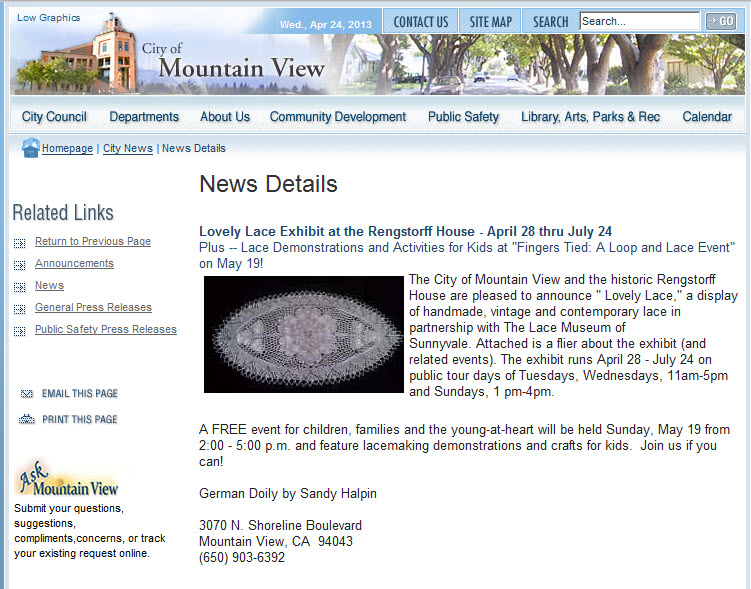
The Lovely Lace exhibit, sponsored by The Lace Museum in Sunnyvale, will run from April 28 - July 24, with a special family day on May 19. On family day, they will have lace-making demonstrations and kids activities.

This was a surprise for me: The City of Mountain View featured my doily on its event page!


Sunday, March 03, 2013

Dreambird and a Swing Knitting Class


Oh, Dreambird.  I've learned to love you, but it's been a rocky relationship.  In the beginning, I was infatuated with your bright colors and curvy shape.  You promised to be exciting, with daring twists and turns.  Little did I know how you would taunt me.


Engulfed in passion, I knit two feathers back in January.  The pattern, translated from German to English, was confusing at first, but then the designer released a chart with stich counts per row that made the knitting go more smoothly.  I'm about halfway done, and I'm enjoying it so much, I think I may make another with different yarn and colors.

This technique of Swing Knitting spurred me to look for other patterns and for guidance.

Since I became enamored with the Dreambird pattern, I decided to take a Swing Knitting class at Stitches West with Brigitte Elliott.  Brigitte went to Germany to learn about Swing Knitting from its pioneers.  The Stitches class was sold out, but fortunately, I was on the waitlist, and I got a call a week or two before Stitches began -- I was in!

Brigitte is a marvelous teacher.  She is very patient, yet takes into consideration that some students are advanced and want to forge ahead.  Her printed course materials are easy to follow and complete, including references.  She provided formulae for creating our own swing knitting designs, as well as tried-and-true techniques, like placing locking stitch markers or pins to indicate turns.  She also brought several examples of swing knitting that she had created.  I'm excited that she's working on new patterns using this technique.


She also presented a slide show with examples of inspiring Swing Knitting wall art.  Take a look at this German website to see what beautiful works of art have been created with Swing Knitting.  (When you get there, click on Gestrickte Kunst to view the artwork.)

Skacel provided all the materials for this class for free.  Not only did we receive three balls of yarn, but also an Addi Lace circular  needle.  The yarn provided included a Zauberball variegated that really pops against the solid color background.


If you are considering beginning your own swing knitting project, I would advise joining the Swing Knitting group on Ravelry.  Also, take a few moments to learn German short rows from a Youtube video.  No wraps are required, it's simple and leaves no holes in the knitted fabric.


Monday, January 28, 2013

Dreambird: 2 Feathers

First two feathers of my Dreambird are completed.  You can see where this is headed.  The lighting for this photo isn't great, but I'm happy with the progress thus far.

The row-by-row chart in English was released and already updated once (separate file). It did clear up at least one bit of confusion, which is why there may be a couple of rows extra between my feathers one and two and less between subsequent feathers.  As an example, the pattern may indicate "knit back" when you only need to knit back to the last double stitch, rather than all the way to the end.

I've found it's helpful to read the row-by-row chart, just prior to knitting the next pattern Step.  I may write the number of stitches next to each Step on my copy, just to avoid any confusion.

I'm now ready to zoom through this pattern and complete it, possibly before Stitches West in February!

Thursday, January 24, 2013

Dreambird

While roaming around on Ravelry, I noticed a lovely pattern called Dreambird, based on the Swing Knitting fad that has leapt from Europe to America.  So popular is this soon-to-be-ubiquitous, short-row technique that all of the Swing Knitting classes at Stitches West are sold out. (I am on the waitlist for either a Saturday or Sunday class.)

Silly me, I latched onto the Dreambird pattern as soon as I saw it.
Photo: Nadita Swings
Pretty bird!  The designer started a KAL and offered the pattern at a reduced price until the end of February.  I couldn't resist.  I downloaded it and paid all of 3.50 EUR. No biggie, right?

The pattern was originally written in German, I believe.  Then it was translated into English, French, Dutch, Russian, Spanish, etc.  Thankfully, the designer speaks English rather fluently, but with the weird quirks that come from learning English as a second or third language. Some of the original English-speaking KAL members are frustrated and some have dropped out.  I am now patiently waiting for a promised pattern update that will decipher the pattern's now infamous turn-by-turn instructions.  The designer is very responsive, and I do believe she will address all issues.

My simple beginning has turned into the elephant in my knitting bag, demanding attention, yet I'm trying to ignore it in favor of finishing the Evenstar shawl, at least until the pattern update is released.

Swing knitting aficionados are enamored with the use of pins to mark the turns in their work. These can be especially important when creating the more complicated swing pieces you may have already seen popping up on knitting websites and in magazines. For the Dreambird, they are not especially critical, but they are a good introduction to the use of pins to mark the German short-row turns.

My humble beginning:

Tuesday, October 30, 2012

Evenstar - Beginning Beaded Border

Headed for the border
I'm just at the border of Evenstar, the lace shawl pattern by Susan Pandorf.  The shawl is knit with Findley, merino and silk laceweight, by Juniper Moon Farm. The yarn is one of my favorites for knitting lace. I had two balls of the Renaissance color in my stash, and this seemed like the perfect project for it.  Juniper Moon Farm has come out with some new appealing colors, too.

A peek at the central portion
A progress photo is below.  The beaded border is about 20 sts deep, knit perpendicularly to the edge of the shawl.  There are five beads added on every wrong side row, and nearly 3,000 beads are required.  I'm using size 8/0 glass Miyuki beads with this yarn, and a #10 steel crochet hook to add them as I knit.  I bought some of them from Twisted Sistahs at Stitches last year, but didn't have enough.  To make up the difference, I looked online and found a great bead supplier, Auntie's Beads. This was my first time ordering from this supplier. The beads can be purchased at a reasonable price, and they arrived in about four days.  You can shop by size or type, and I'm quite pleased with the overall ease of the experience.

Miyuki - Japanese glass beads
At first, the number of beads may seem daunting, but it's easy to fall into a rhythm while you're adding them.  I've done wider lace borders, but not with this many beads.  The beading does slow you down, but the results are stunning, and it's worth the extra effort. 

Starting the border
To work the border, I'm using a US4 DPN the same size as my circular.  One point protector stays on the end of the circular that's holding all the stitches. I crocheted a chain of about 25 sts from which to cast on provisionally the 16 sts required to begin the border -- the working yarn from the body of the shawl is not cut and is used to cast on this base row.  This may seem fiddly, and it may take a couple of tries to get the right tension to begin the border pattern.  I tried to cast on very close to the last stitch of the body of the shawl, to eliminate any large holes or gaps that would show when the final border row is grafted to the first border row.

For the beading, I purl the stitch that requires the bead, then I transfer it back to the left needle.  I pick up a bead with the #10 crochet hook. I pull the transferred stitch off of the left needle with the hook and slide it through the bead.  Then I move the stitch with the bead over to the right needle.  Then I tug the working yarn a bit to snug up the beaded stitch.  Like I said, the process will slow you down, but as you do more, it becomes a rhythm, and you will get faster and faster.

The work stays to the left as I knit the right side rows, and to the right on the wrong side rows.Using the DPN makes it easy for me to flip the work back and forth.  I tend to keep the crochet hook behind my right ear or resting on my lap.  The seed beads are in a flat, round container, about 2" in diameter that has a tight-fitting lid.  I keep a single layer of beads in the container and replenish as needed.  It's helpful to set the bead container on a cloth, or non-slippery surface, so it doesn't move around as you are picking up beads.

Ellie wants me to post photos of the completed shawl very soon so we can get back to our regular play schedule :)

Ellie hopes that I'll be finished very soon

Tuesday, September 18, 2012

Tulip Dress and Evenstar

I made this sweet little pink Tulip Lace Dress for my friend's grandbaby, due in October.  It's a free pattern on Paton's website, but you do need to sign in to download.  The yarn is Paton's Grace, 100% mercerized cotton.  Although the yarn suggests hand washing, I put this through the washer and dryer (with fingers crossed) and it came out perfectly.


The project on my needles at the moment is Evenstar by Susan Pandorf.  It's  a lovely design, and I'm hoping it turns out as well as some of those I've seen on Ravelry.  The yarn is Findley, by Juniper Moon Farms and the color is Renaissance. You can find it many yarn stores.  I've just started Chart 3 and have graduated to a 47" Addi lace needle, size US3.  This shawl is going to be pretty large, maybe 60" in diameter.


My first Findley project was the Lace Baby Blanket I knit for Tanis Gray for the Findley launch. The book is still available. That's the blanket on the cover.